Was an Art Movement That Was Formed in 1916 as a Reaction to the Horror of World War 1
Articles & Features
What is Dadaism, Dada Fine art, or a Dadaist?
As a word, it is nonsense. Equally a movement, however, Dada art proved to exist i of the revolutionary art movements in the early on twentieth century. Initially conceived by a loose band of avant-garde modernists in the prelude to World War I just adopted more fully in its wake, the Dadaist celebrated luck in identify of logic and irrationality instead of calculated intent.
Know someone who would find this article interesting?
Fundamental dates:1916-1924
Key regions:Switzerland, Paris, New York
Keywords:Chance, luck, nonsense, anti-art, readymade
Key artists:Hugo Ball, Marcel Duchamp, Hans (Jean) Arp, Sophie Taeuber-Arp, Hannah Höch, Human being Ray, Francois Picabia
Key characteristics: Humoristic, tending towards the cool, satirical attitude towards authorisation
Dadaism: Origins and Fundamental Ideas of the Fine art Movement
During the First World War, countless artists, writers, and intellectuals who opposed the war sought refuge in Switzerland. Zurich, in particular, was a hub for people in exile, and it was here that Hugo Brawl and Emmy Hemmings opened the Cabaret Voltaire on February 5, 1916. The Cabaret was a meeting spot for the more radical avant-garde artists. A cross betwixt a nightclub and an arts center, artists could exhibit their piece of work at that place amid cutting-edge verse, music, and dance. Hans (Jean) Arp, Tristan Tzara, Marcel Janco and Richard Huelsenbeck were among the original contributors to the Cabaret Voltaire. Every bit the war raged on, their fine art and performances became increasingly experimental, dissident and anarchic. Together, they protested against the pointlessness and horrors of the war under the battle cry of DADA.
The key premise behind the Dada art motility (Dada is a colloquial French term for a hobby horse) was a response to the mod age. Reacting confronting the rise of capitalist civilization, the war, and the concurrent deposition of art, artists in the early 1910s began to explore new art, or an "anti-art", every bit described by Marcel Duchamp. They wanted to contemplate the definition of art, and to exercise so they experimented with the laws of hazard and with the found object. Theirs was an art grade underpinned by humor and clever turns, but at its very foundation, the Dadaists were asking a very serious question almost the role of fine art in the modern age. This question became fifty-fifty more pertinent as the reach of Dada art spread – past 1915, its ideals had been adopted by artists in New York, Paris, and beyond – and every bit the earth was plunged into the atrocities of Globe War I.
Advent of the Readymade
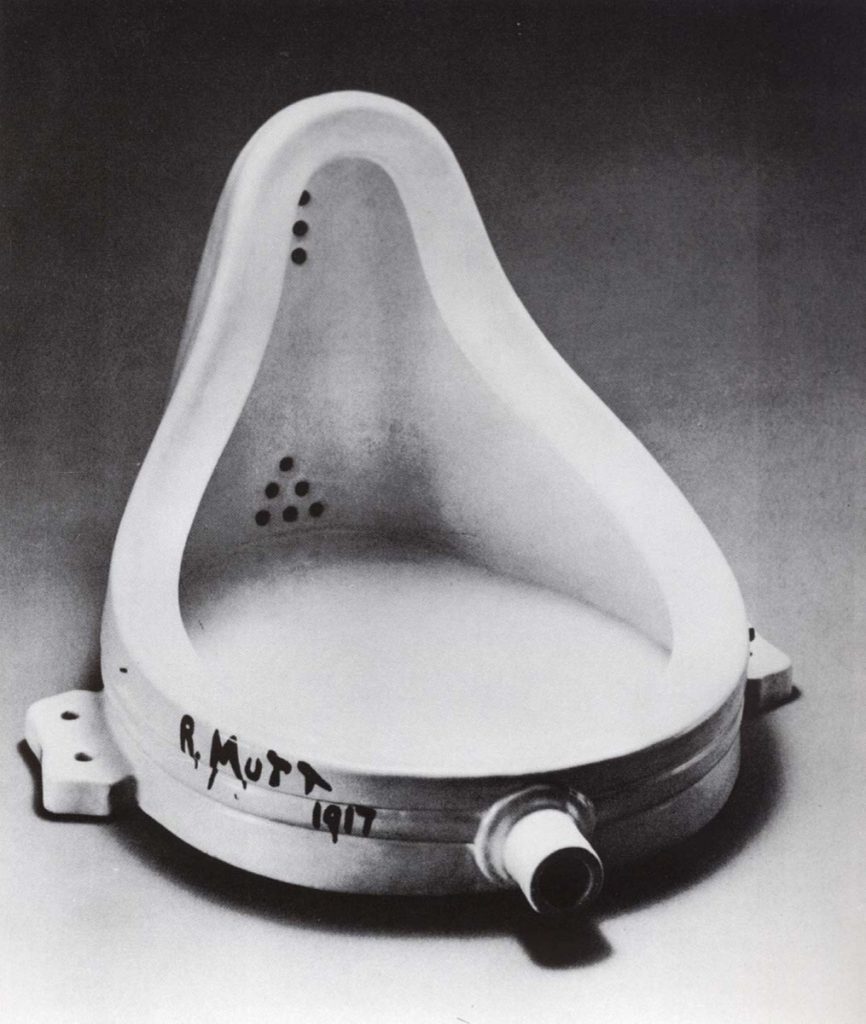
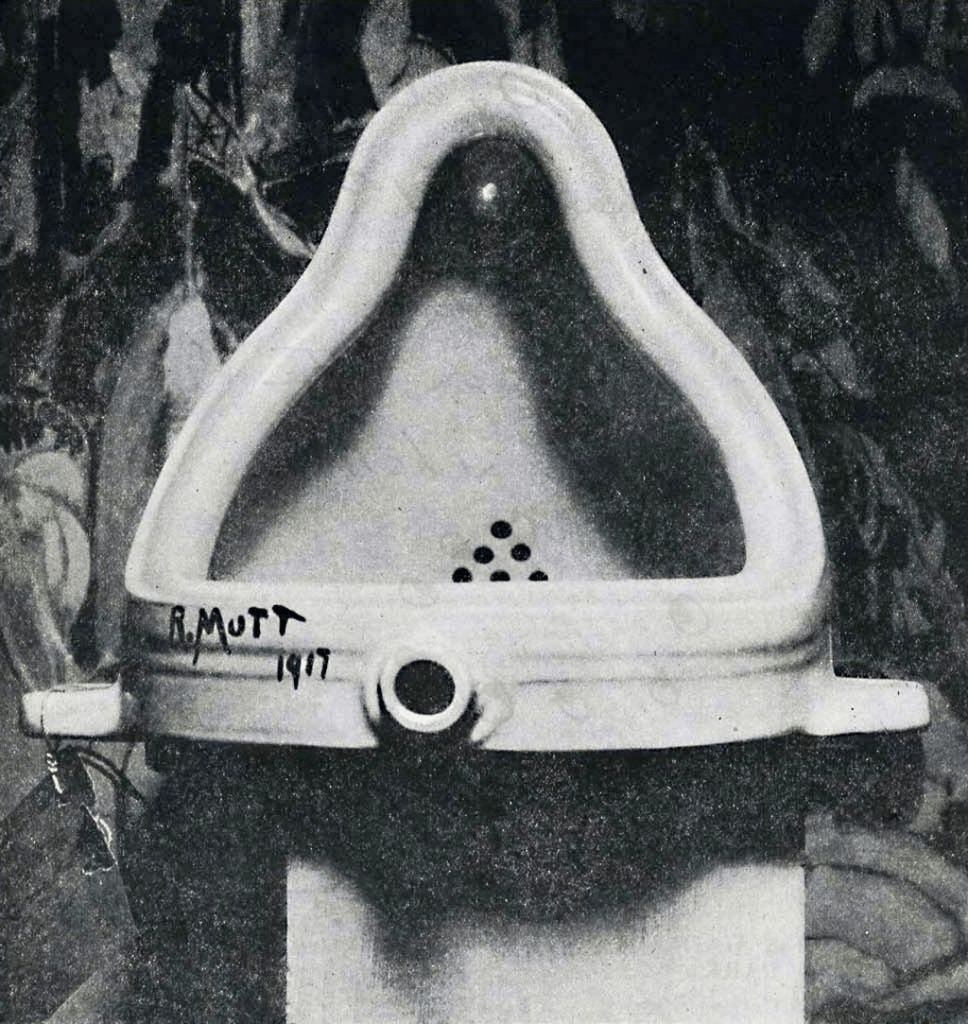
One of the about iconic forms to sally amidst this flourish of Dadaist expression was the readymade, a sculptural form perfected by Marcel Duchamp. These were works in which Duchamp repurposed found or factory-made objects into installations. In Advance a Cleaved Arm (1964), for instance, involved the intermission of a snow shovel from a gallery mount; Fountain (1917), arguably Duchamp's most recognizable readymade, incorporated a mass-produced ceramic urinal. Past taking these objects out of their intended functional space and elevating them to the level of "art," Duchamp poked fun at the fine art establishment while also request the viewer to seriously contemplate how nosotros appreciate fine art.
Different modes of Dadaism
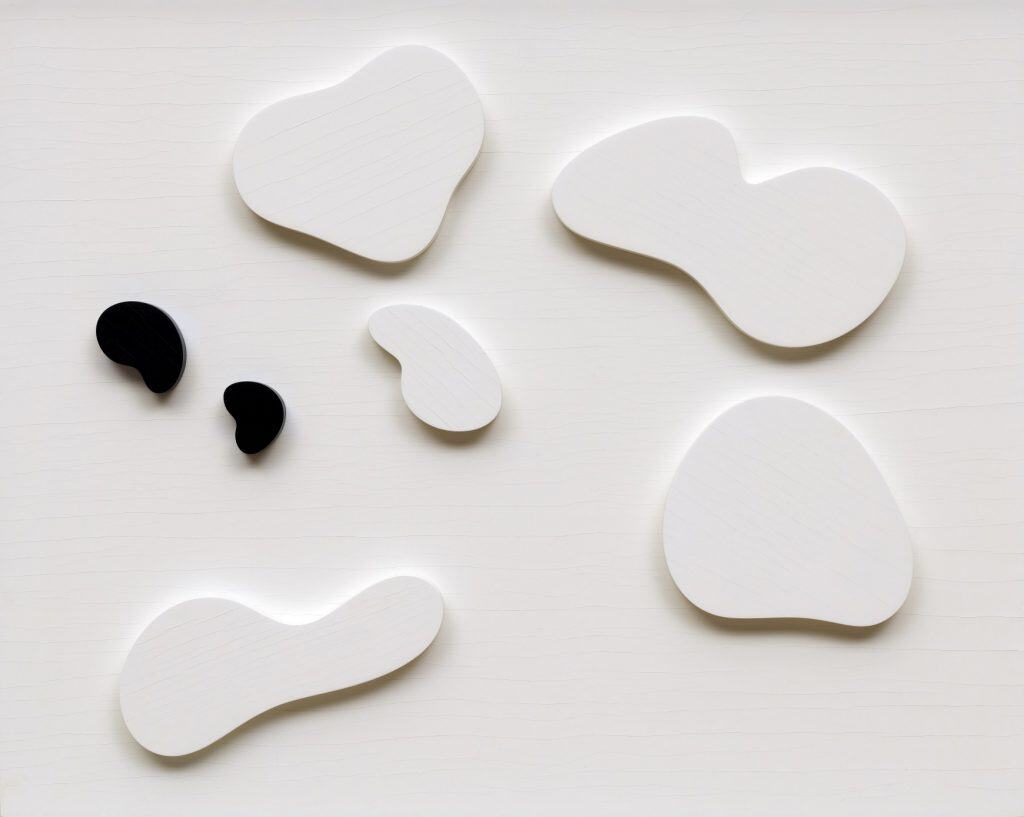
As Duchamp's readymades exemplify, the Dadaists did not shy away from experimenting with new media. For instance, Jean Arp – a sculptor who pioneered dadaism – explored the art of collage and the potential for randomness in its creation. Man Ray also toyed with the arts of photography and airbrushing as practices that distanced the hand of the creative person and thus incorporated collaboration with a chance. Beyond these artistic media, the Dadaists likewise probed the literary and performance arts. Hugo Ball, for instance, the man who penned the unifying manifesto of Dadaism in 1916, investigated the liberation of the written word. Freeing text from the conventional constraints of a published folio, Ball played with the ability of nonsensical syllables presented as a new course of poetry. These Dadaist poems were often transformed into performances, assuasive this network of artists to move easily between media.
Examples of Famous Dada Artworks
The motility has brought many famous artworks. Here are a selected few examples of dadaism artworks:
- Marcel Duchamp's Fountain (1917)
- Marcel Duchamp's Bicycle Bicycle (1913)
- Man Ray's Ingres's Violin (1924)
- Hugo Ball's Sound Verse form Karawane (1916)
- Raoul Hausmann'due south Mechanical Head (The Spirit of our Time) (1920)
1. Marcel Duchamp'south Fountain (1917)
In 1917, Marcel Duchamp submitted a urinal to the Society of Independent Artists. The Lodge refused Fountain because they believed it could not be considered a piece of work of art. Duchamp's Fountain raised countless important questions about what makes art art and is considered a major landmark in 20th-century fine art.
ii. Marcel Duchamp'due south Bicycle Bicycle (1913)
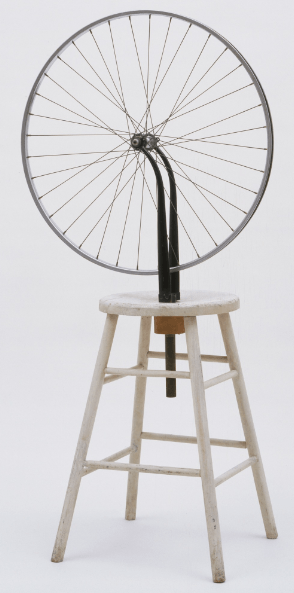
"In 1913, I had the happy thought to fasten a wheel wheel to a kitchen stool and sentinel it plow," said Marcel Duchamp most his famous piece of work Bike Bicycle. Bicycle Wheel is the starting time of Duchamp's readymade objects. Readymades were private objects that Duchamp repositioned or signed and called art. He called Wheel Bike an "assisted readymade," made by combining more than one commonsensical item to course a work of art.
3. Human Ray's Ingres'southward Violin (1924)
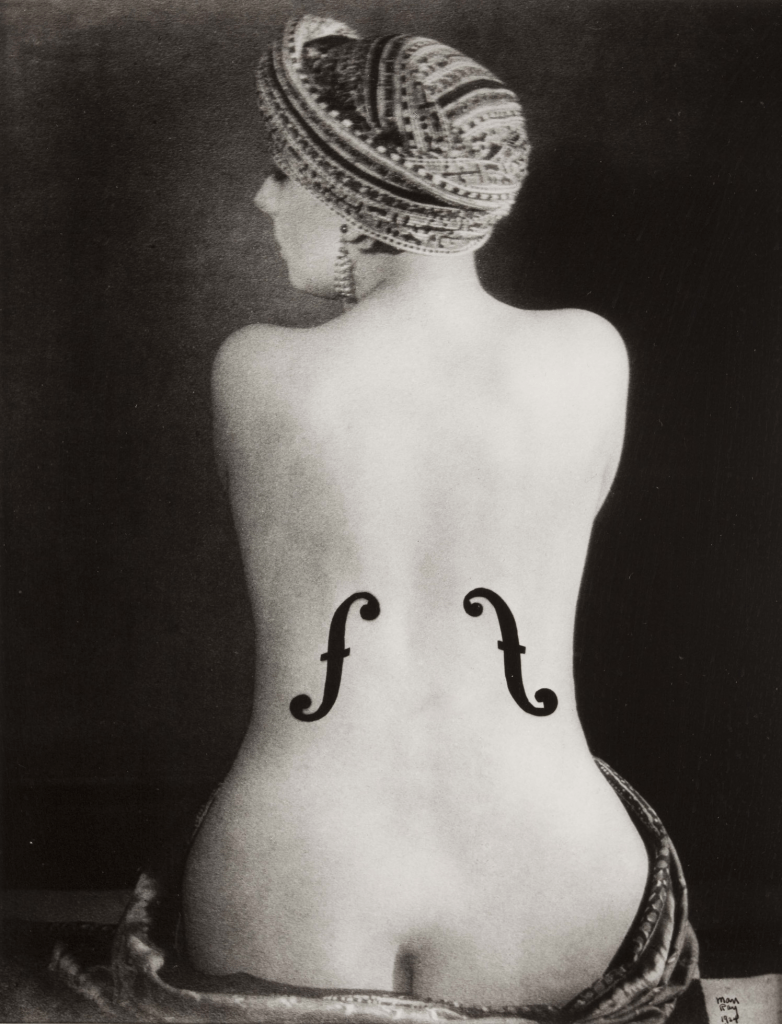
By painting f-holes of a stringed instrument onto the photographic print of his nude model Kiki de Montparnasse and rephotographing the print, Human being Ray contradistinct what was originally a classical nude. The female body was now transformed into a musical instrument. He also added the title Le Violin d'Ingres, a French idiom that ways "hobby."
4. Hugo Ball'south Sound Poem Karawane (1916)
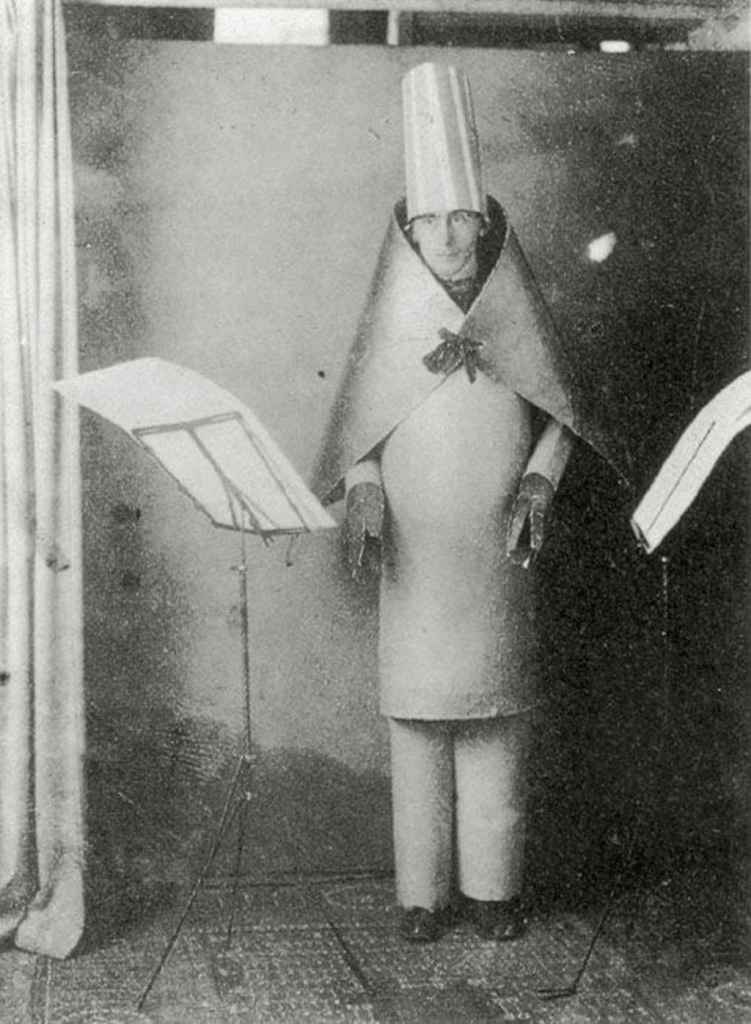
Founder of the Cabaret Voltaire and writer of the outset Dadaist Manifesto in 1916, about of Ball's piece of work was in the genre of sound poetry. In 1916, the same yr in which the published the get-go Dadaist Manifesto, Ball performed the sound poem Karawane. The opening lines were:
jolifanto bambla o falli bambla
Hugo Ball
großiga m'pfa habla horem
The rest of the poem continued much forth the same lines. Though the poem could be dislocated with random, mad ramblings, audio-verse was actually a securely considered method in the experimental literature. The idea was to bring the sounds of human vocalization to the foreground by removing everything else.

five. Raoul Hausmann's Mechanical Caput (The Spirit of our Time) (1920)
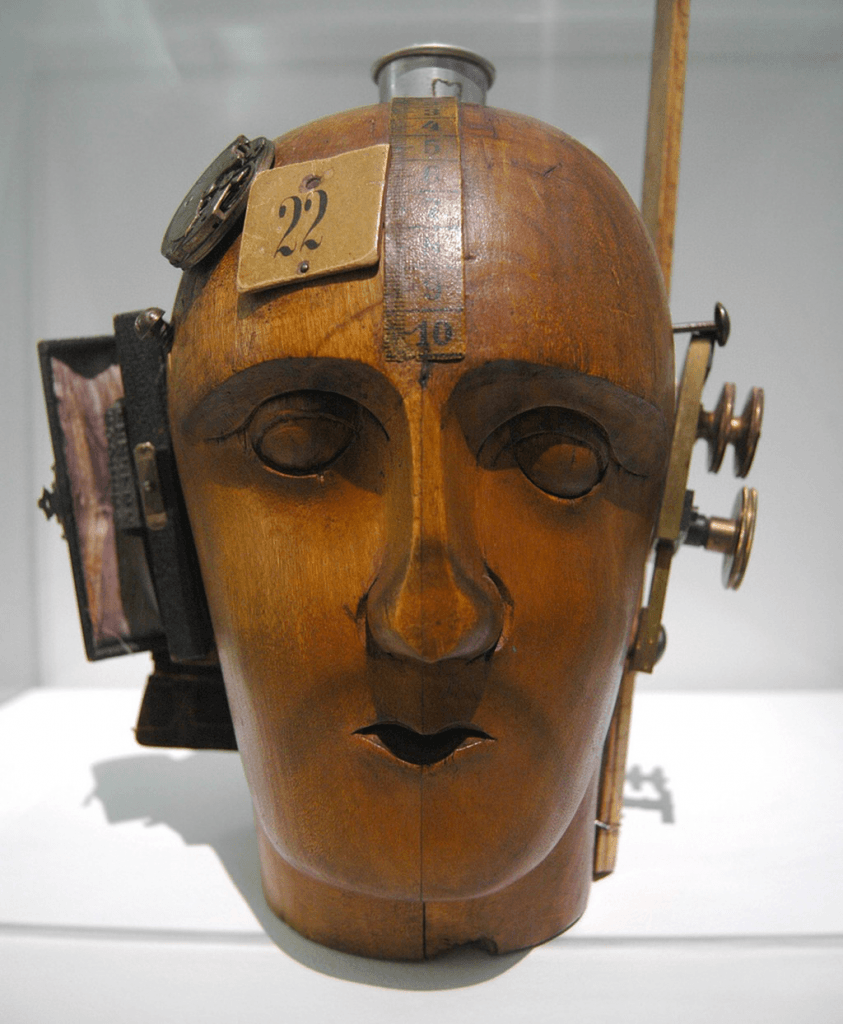
Raoul Hausmann was a poet, collagist, and operation artist, who is all-time known for his sculpture entitled Mechanical Caput (The Spirit of Our Time). The manikin head made from a solid wooden block is a reversal of Hegel's assertion that "everything is mind." For Hausmann, homo is airheaded "with no more than capabilities than that which run a risk has glued to the outside of his skull." By raising these topics, Hausmann wanted to compose an image that would shatter the mainstream Western conventions that the caput is the seat of reason.
Reception, Downfall, and Broadcasting of Dadaist Ideals
The bold new approaches of the Dadaists stirred controversy within contemporary culture. Their swift intermission from tradition, their impassioned pursuit of a new way of expression, and their willingness to bring the revered world of "fine art" back to a more level and egalitarian playing field through both humor and inquisitive investigation allowed Dada artists to attract both fans and foes of their work. Some saw Dadaist expression as the side by side step forrad in the advanced march; others missed the significance and instead saw works, such as Duchamp's readymades, as not art but just their elective objects (leading to some of the originals being relegated to the decline pile).
Dadaism gripped audiences into the 1920s, but the move every bit a whole was destined to crumble. Some, similar Man Ray, found their inclinations moving into the subconscious realm of Surrealism; others found the pressures on the modern European artist too weighty to conduct. The rise to ability of Adolf Hitler in the 1930s dealt a powerful accident to the modern art world, as the maniacal despot sought to rout out the roots of modern art, a field he considered "degenerate." Equally a result, Dada artists witnessed their works mocked or destroyed and thus chose to escape the stifling air of Europe for the more liberated creative climate of the United States and beyond.
Idea many of these initial members scattered, the ideals of Dadaism remained alive and well amid contemporary artists. In many regards, 1 tin can see the threads of Dada revived. For example, during the Pop Art era, Neo- Dadaism presented motifs and cultural commentaries interpreted with a hint of Dadaist intrigue. Just information technology was in the latter half of the twentieth century that the full impact of the Dadaist moment was realized. In addition to the ii major international retrospectives dissecting the Dadaist oeuvre (one in 1967 in Paris and another in 2006 at various international venues), greater research was lavished on the comprehension and preservation of their legacy.
Collecting Dada Fine art
Though offer a universal entreatment, Dadaist works can prove a claiming to collect. Beyond issues of authenticity, information technology is hard to chart or projection the prices such works volition attain, a problem owed to the sheer diverseness of media. That being said, ane can annotation the consistency with which Dadaist works have exceeded expectations at auction. The notable sale of Marcel Duchamp's Nu sur nu (1910-1911) for more than than $i.4 million in June 2016 doubled the estimated sales price of between $555,000 – $775,000. François Picabia's Ventilateur (1928) sold at Sotheby's in February 2016 for more than $iii.i 1000000 at the higher end of its predicted sales range. What this trend seems to suggest is that the interest in Dada fine art expression and the Dada movement is however alive and well, with collectors knowledgeable with regards to the adept deals that might pop up at auction.
FAQ
What is Dadaism?
Dadaism is an artistic motility from the early on 20th century, predating surrealism and with its roots in a number of major European artistic capitals. Developed in response to the horrors of WW1 the dada movement rejected reason, rationality, and order of the emerging capitalist society, instead favoring chaos, nonsense, and anti-bourgeois sentiment.
Who are the principal Dadaist artists?
The most renowned Dada artists are Marcel Duchamp, Francis Picabia, and Homo Ray in Paris, George Grosz, Otto Dix, John Heartfield, Hannah Höch, Max Ernst, and Kurt Schwitters in Germany, and Tristan Tzara, Richard Huelsenbeck, Marcel Janco and Jean Arp in Zurich.
Where did Dadaism originate?
There is some disagreement as to where Dada was founded. Many believe that the motility first developed in the Cabaret Voltaire, an advanced nightclub in Zurich, others merits a Romanian origin. What is clear is that there was a pan European sensibility emerging during WW1, specially during 1916, and that clear adherents the main themes can be identified in Zurich, Berlin, Paris, Hanover, Cologne, the netherlands and even as far away as New York.
What are the chief characteristics of dadaism?
A Dadaism is often characterized by humor and whimsy, tending towards the cool. This kind attitude was used as a satirical critique of the prevailing societal and political systems, to which the onslaught of WWI was largely attributed to.
What does dadaism mean?
The name Dada is one derived from nonsense and irrationality. In some languages, it meant 'yes, yes' equally a parody of the population's senseless obedience to authorisation, whilst in others, it had completely dissimilar meanings and connotations. The name is attributed to Richard Huelsenbeck and Hugo Ball, although Tristan Tzara also claimed authorship – the idea being that information technology would have multiple nonsense meanings.
How is dadaism a reaction to WW1?
Dadaism was a motion with explicitly political overtones – a reaction to the senseless slaughter of the trenches of WWI. It essentially declared war confronting war, countering the applesauce of the establishment's descent into chaos with its own kind of nonsense.
Which composer was nigh closely associated with dadaism?
Dada ideal also extended to the field of sound. Amid others, Francis Picabia and Georges Ribemont-Dessaignes realized Dada music to be performed at the 1920 Festival Dada, but also renowned composer Erik Satie also dipped into Dadaist audio experiments.
Read more than nearly Art Movements and Styles Throughout History hither.
Know someone who would find this commodity interesting?
Source: https://magazine.artland.com/what-is-dadaism/

Postar um comentário for "Was an Art Movement That Was Formed in 1916 as a Reaction to the Horror of World War 1"