The Angle Bisectors of a Triangle Can Only Intersect Where?
The Angle Bisectors
For every angle, there exists a line that divides the bending into two equal parts. This line is known as the angle bisector. In a triangle, at that place are iii such lines. Three angle bisectors of a triangle meet at a point chosen the incenter of the triangle. There are several ways to see why this is and then.
- Bending Bisectors as Cevians
This is Corollary ii of Ceva's theorem.
Allow'south here show the required proportion. Let AD be the bending bisector of angle A. The area of a triangle can be computed in many ways. I'll apply ii of them to compute the areas of triangles ABD and ACD. Permit a denote half the bending BAC. Then
Area(ABD) / Area(ACD) = [AB·Ad·sin(a)/2] / [AC·Advertising·sin(a)/2] = AB / AC.
On the other mitt, if AHa is the altitude from A to BC, then
Area(ABD) / Area(ACD) = [AHa·BD/ii] / [AHa·CD/two] = BD / CD.
Combining the two gives the required identity:
AB / AC = BD / CD. (A dynamic analogy of a dissimilar proof tin exist found elsewhere. And there is another i.)
- Via Transitivity of Equality
An angle bisector of an angle is known to be the locus of points equidistant from the two rays (half-lines) forming the angle. Existence of the incenter is then a consequence of the transitivity property of equality.
- Angle Bisectors as Axes of a two-line
If we adopt Frank Morley's outlook, transitivity of equality will still exist present but only implicitly.
An angle bisector tin can be looked at equally the locus of centers of circles that touch on ii rays emanating from the same signal. In a triangle, there are three such pairs of rays. Choice any angle and consider its bisector. Circles that touch two sides of the angle have their centers on the bisector. Conversely, whatsoever bespeak on the bisector serves as the center of a circumvolve that touches both sides of the bending. Consider ii bisectors of angles formed by the pair a and b and by the pair b and c. The circle with the middle at the point of intersection of the 2 bisectors touches all three sides. In detail, it touches the sides a and c and, therefore, has its center on the bisector of the angle formed by these two sides.
- Angle Bisectors as Altitudes
Altitudes of a triangle serve as angle bisectors of the associated orthic triangle. This clan can be used in reverse.

Consider ΔABC. Through each vertex draw a line perpendicular to the corresponding angle bisector. These iii lines will form a triangle - say ΔA'B'C'. Note that, since A'B' is perpendicular to CLc, ∠BCA' = ∠ACB'. The same is true of the pairs of angles at vertices A and B. Allow's call this a mirror property. As we know, the orthic triangle of ΔA'B'C' has the mirror belongings. We'll brand employ of this observation shortly.
What we have to testify now is that the bisectors ALa, BLb, and CLc pass through the vertices A', B', and C', respectively. Presume to the contrary, that at least one of them does not laissez passer through the respective vertex. Then the orthic triangle of ΔA'B'C' could not possibly coincide with ΔABC. But, assuming they are unlike, in the ΔA'B'C' there would be 2 singled-out inscribed triangles (ABC and the orthic) that possess the mirror holding. However, it can be shown that this is impossible. There is only 1 triangle with that holding. (For other properties of the orthic triangle see the discussion on Fagnano's trouble.)
The proof is pretty simple.
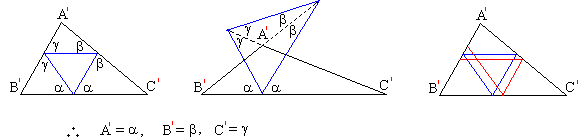
It appears that angles in a triangle with the mirror property are not arbitrary. Count the angles in the diagram. (Ii cases - of birdbrained and acute-bending triangles - should be considered separately. In the sometime instance, instead of talking of inscribed triangles, nosotros should consider triangles with vertices on the sides, or the extensions thereof, of a given triangle.) Whatsoever triangle with the mirror property must have the same angles as the orthic triangle and take its sides parallel to the latter. As the third diagram suggests, this is conspicuously impossible for a triangle different from orthic. (Like considerations worked in one of the proofs of Morley's Theorem.)
- Complex numbers
As in the study of altitudes, let vertices of a given triangle be located on the unit circle. For convenience sake, lets accept them to be squares of complex numbers: ten1 2, 102 2, and xiii ii. The midpoint of the arc x1x2 opposite the vertex xiii is so equal ±x1x2. And similarly for midpoints of arcs x2xiii and 101x3. Let's choose xi, ten2, xiii such that all the signs are taken to be "+". The clinant of the line through x110ii and x3 (the angle bisector at the vertex xiii) is given by
M = (y3 2 - y1y2)/(x3 ii - xanex2) = - 1/(xix2xiii 2) which readily gives an equation of the angle bisector
y = - (10 - 101x2)/(101xtwoxiii 2) + y1y2
Write downwards a like equation for a second angle bisector, for instance,
y = - (x - x1x3)/(xonex3xtwo 2) + yoneythree
and solve the 2 equations for y. As x is the cohabit of y, with a little effort the result reduces to
x = - (x1x2 + x210iii + ten3ten1)
a symmetric expression of all three indices. Therefore, this point too belongs to the third angle bisector.
References
- Liang-shin Hahn, Complex Numbers & Geometry, MAA, 1994

Related cloth | |
Angle Bisector | |
| | |
| | |
| | |
| | |
| | |
| | |
| | |
| | |
| | |
| | |
| | |
| | |
| | |
| | |
| | |
| | |
| | |
| | |
| | |
|Contact| |Front page| |Contents| |Geometry| |Eye opener|
Copyright © 1996-2018 Alexander Bogomolny
Source: https://www.cut-the-knot.org/triangle/ABisector.shtml

Postar um comentário for "The Angle Bisectors of a Triangle Can Only Intersect Where?"