Reviewing Key Concepts Major Animal Phyla Mastering Biology Answers
Chapter ane: Introduction to Biology
1.1 Themes and Concepts of Biological science
Past the terminate of this section, you will be able to:
- Identify and draw the backdrop of life
- Describe the levels of organization among living things
- List examples of unlike sub disciplines in biology
Picket a video about Evolution past Natural Choice.
Biology is the science that studies life. What exactly is life? This may sound like a silly question with an obvious answer, simply information technology is not easy to ascertain life. For example, a branch of biology called virology studies viruses, which exhibit some of the characteristics of living entities merely lack others. It turns out that although viruses can attack living organisms, cause diseases, and fifty-fifty reproduce, they exercise not see the criteria that biologists use to define life.
From its primeval beginnings, biology has wrestled with iv questions: What are the shared properties that make something "alive"? How do those diverse living things function? When faced with the remarkable multifariousness of life, how do we organize the different kinds of organisms and then that nosotros can improve sympathise them? And, finally—what biologists ultimately seek to understand—how did this diversity ascend and how is it continuing? As new organisms are discovered every 24-hour interval, biologists go along to seek answers to these and other questions.
Backdrop of Life
All groups of living organisms share multiple cardinal characteristics or functions: order, sensitivity or response to stimuli, reproduction, adaptation, growth and development, regulation, homeostasis, and energy processing. When viewed together, these eight characteristics serve to define life.
Order
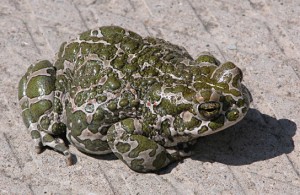
Organisms are highly organized structures that consist of 1 or more cells. Even very unproblematic, single-celled organisms are remarkably complex. Within each cell, atoms make upward molecules. These in turn make up cell components or organelles. Multicellular organisms, which may consist of millions of individual cells, have an reward over single-celled organisms in that their cells can be specialized to perform specific functions, and fifty-fifty sacrificed in certain situations for the expert of the organism as a whole. How these specialized cells come together to grade organs such as the centre, lung, or skin in organisms like the toad shown in Figure 1. 2 will be discussed afterwards.
Sensitivity or Response to Stimuli
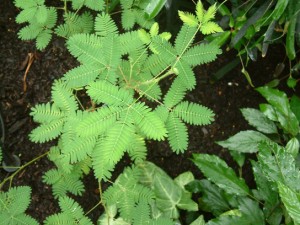
Organisms respond to diverse stimuli. For case, plants can bend toward a source of light or respond to touch on. Even tiny bacteria tin motion toward or away from chemicals (a process called chemotaxis) or calorie-free (phototaxis). Motility toward a stimulus is considered a positive response, while movement away from a stimulus is considered a negative response.
Concept in Action

Watch this video to see how the sensitive found responds to a touch stimulus.
Reproduction
Single-celled organisms reproduce by get-go duplicating their DNA, which is the genetic material, and and then dividing it equally as the jail cell prepares to divide to form 2 new cells. Many multicellular organisms (those fabricated up of more than one cell) produce specialized reproductive cells that will form new individuals. When reproduction occurs, Dna containing genes is passed forth to an organism's offspring. These genes are the reason that the offspring will belong to the same species and will have characteristics similar to the parent, such as fur color and claret blazon.
Adaptation
All living organisms exhibit a "fit" to their surroundings. Biologists refer to this fit as accommodation and it is a effect of evolution by natural pick, which operates in every lineage of reproducing organisms. Examples of adaptations are diverse and unique, from heat-resistant Archaea that live in boiling hot springs to the tongue length of a nectar-feeding moth that matches the size of the bloom from which it feeds. All adaptations enhance the reproductive potential of the individual exhibiting them, including their ability to survive to reproduce. Adaptations are not constant. Equally an environment changes, natural choice causes the characteristics of the individuals in a population to rails those changes.
Growth and Evolution
Organisms grow and develop according to specific instructions coded for by their genes. These genes provide instructions that will straight cellular growth and development, ensuring that a species' young will grow upwardly to exhibit many of the same characteristics as its parents.

Regulation
Even the smallest organisms are complex and crave multiple regulatory mechanisms to coordinate internal functions, such as the transport of nutrients, response to stimuli, and coping with ecology stresses. For example, organ systems such as the digestive or circulatory systems perform specific functions like conveying oxygen throughout the trunk, removing wastes, delivering nutrients to every cell, and cooling the torso.
Homeostasis
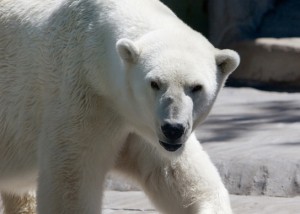
To function properly, cells crave appropriate conditions such equally proper temperature, pH, and concentrations of diverse chemicals. These conditions may, notwithstanding, change from i moment to the next. Organisms are able to maintain internal weather inside a narrow range almost constantly, despite environmental changes, through a process called homeostasis or "steady country"—the ability of an organism to maintain abiding internal conditions. For instance, many organisms regulate their body temperature in a procedure known as thermoregulation. Organisms that live in common cold climates, such every bit the polar bear, have trunk structures that help them withstand low temperatures and conserve torso oestrus. In hot climates, organisms take methods (such equally perspiration in humans or panting in dogs) that help them to shed backlog body heat.
Free energy Processing
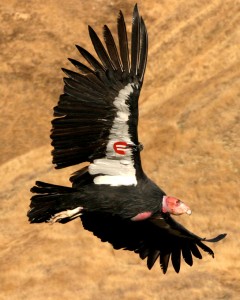
All organisms (such equally the California condor shown in Figure i.6) employ a source of energy for their metabolic activities. Some organisms capture energy from the dominicus and convert it into chemical free energy in food; others employ chemical free energy from molecules they take in.
Levels of Organization of Living Things
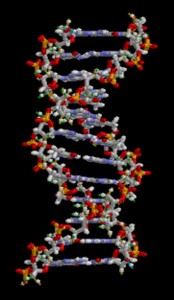
Living things are highly organized and structured, following a hierarchy on a scale from small to big. The cantlet is the smallest and most central unit of affair. It consists of a nucleus surrounded by electrons. Atoms course molecules. A molecule is a chemical structure consisting of at least two atoms held together by a chemical bond. Many molecules that are biologically important are macromolecules, large molecules that are typically formed by combining smaller units chosen monomers. An instance of a macromolecule is deoxyribonucleic acid (DNA), which contains the instructions for the operation of the organism that contains it.
Concept in Action

To meet an animation of this DNA molecule, click here.
Some cells contain aggregates of macromolecules surrounded by membranes; these are chosen organelles. Organelles are small structures that exist within cells and perform specialized functions. All living things are made of cells; the cell itself is the smallest fundamental unit of measurement of structure and function in living organisms. (This requirement is why viruses are not considered living: they are not made of cells. To make new viruses, they take to invade and hijack a living jail cell; only then tin can they obtain the materials they demand to reproduce.) Some organisms consist of a single jail cell and others are multicellular. Cells are classified as prokaryotic or eukaryotic. Prokaryotes are single-celled organisms that lack organelles surrounded by a membrane and do non take nuclei surrounded by nuclear membranes; in contrast, the cells of eukaryotes do have membrane-spring organelles and nuclei.
In most multicellular organisms, cells combine to brand tissues, which are groups of similar cells conveying out the same function. Organs are collections of tissues grouped together based on a mutual role. Organs are nowadays non only in animals but as well in plants. An organ system is a higher level of organization that consists of functionally related organs. For case vertebrate animals have many organ systems, such as the circulatory system that transports blood throughout the body and to and from the lungs; it includes organs such as the heart and claret vessels. Organisms are private living entities. For example, each tree in a woods is an organism. Single-celled prokaryotes and unmarried-celled eukaryotes are as well considered organisms and are typically referred to every bit microorganisms.
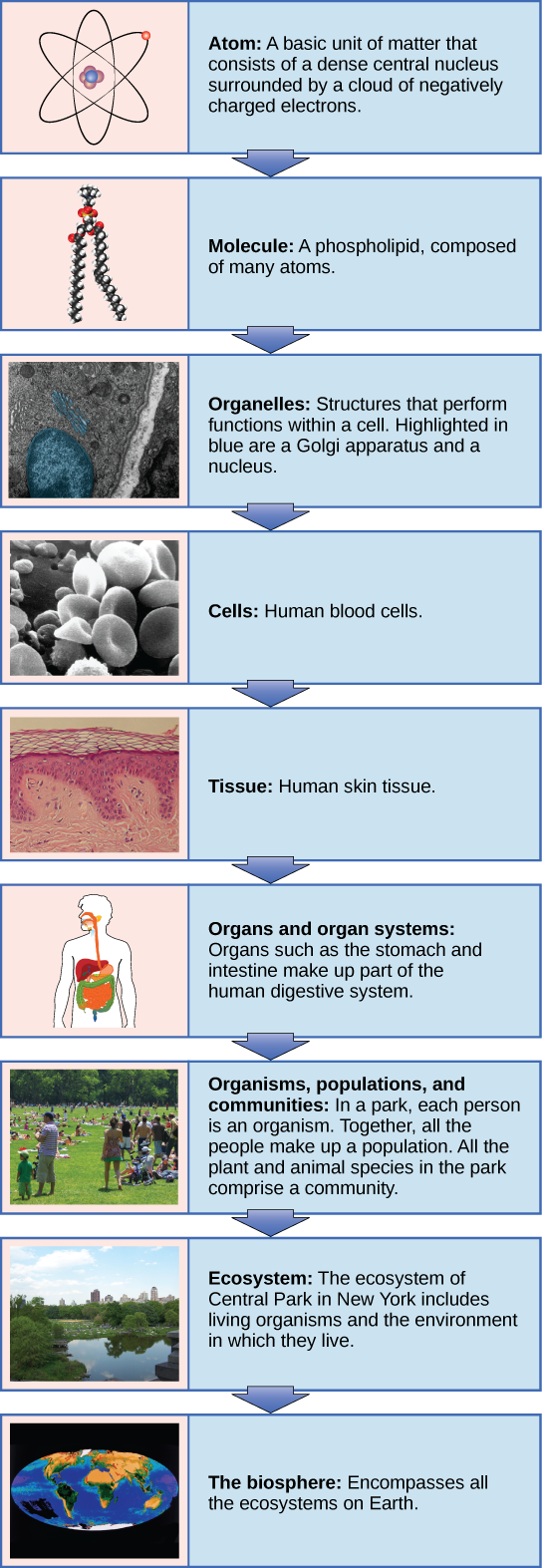
Which of the post-obit statements is false?
- Tissues exist inside organs which exist within organ systems.
- Communities exist within populations which exist inside ecosystems.
- Organelles exist within cells which be within tissues.
- Communities exist within ecosystems which be in the biosphere.
All the individuals of a species living inside a specific area are collectively chosen a population. For example, a wood may include many white pine copse. All of these pine trees represent the population of white pino copse in this forest. Dissimilar populations may live in the same specific area. For example, the wood with the pine trees includes populations of flowering plants and also insects and microbial populations. A community is the set of populations inhabiting a particular area. For instance, all of the copse, flowers, insects, and other populations in a forest form the woods'south community. The forest itself is an ecosystem. An ecosystem consists of all the living things in a particular area together with the abiotic, or not-living, parts of that environs such as nitrogen in the soil or rainwater. At the highest level of organization, the biosphere is the collection of all ecosystems, and information technology represents the zones of life on World. It includes land, h2o, and portions of the atmosphere.
The Variety of Life
The scientific discipline of biological science is very wide in scope considering there is a tremendous diversity of life on Earth. The source of this multifariousness is evolution, the process of gradual change during which new species arise from older species. Evolutionary biologists report the evolution of living things in everything from the microscopic globe to ecosystems.
In the 18th century, a scientist named Carl Linnaeus starting time proposed organizing the known species of organisms into a hierarchical taxonomy. In this system, species that are most similar to each other are put together within a grouping known every bit a genus. Furthermore, like genera (the plural of genus) are put together inside a family. This grouping continues until all organisms are collected together into groups at the highest level. The current taxonomic system now has 8 levels in its hierarchy, from lowest to highest, they are: species, genus, family, order, class, phylum, kingdom, and domain. Thus species are grouped within genera, genera are grouped within families, families are grouped within orders, and then on.
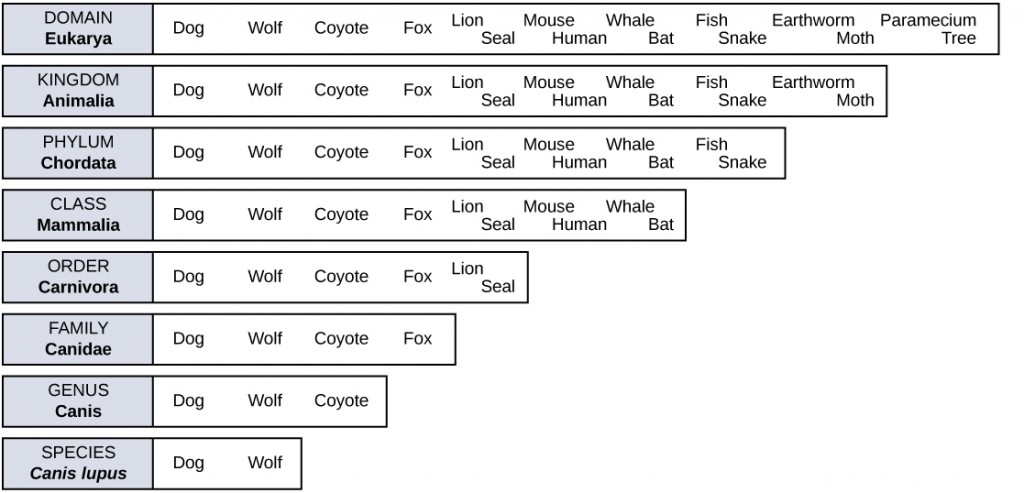
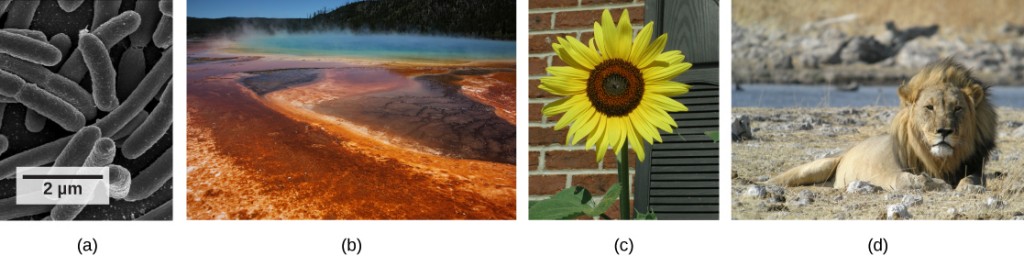
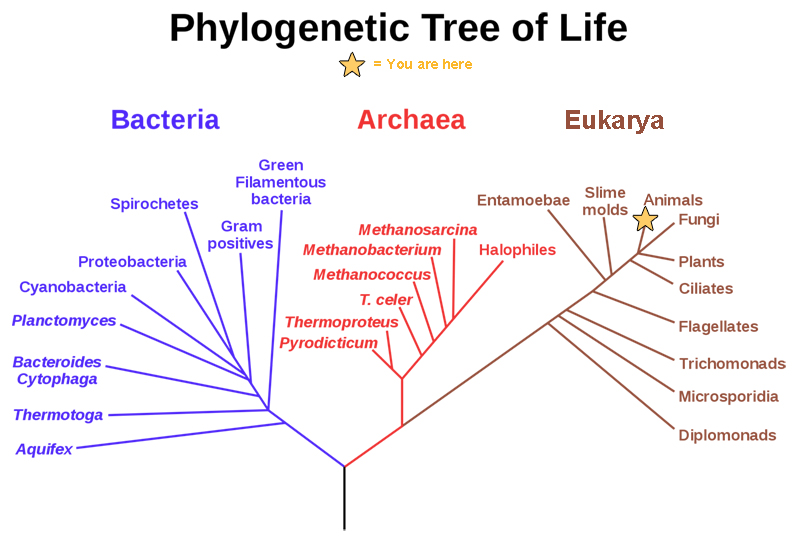
The highest level, domain, is a relatively new addition to the organisation since the 1990s. Scientists now recognize three domains of life, the Eukarya, the Archaea, and the Bacteria. The domain Eukarya contains organisms that have cells with nuclei. It includes the kingdoms of fungi, plants, animals, and several kingdoms of protists. The Archaea, are single-celled organisms without nuclei and include many extremophiles that live in harsh environments like hot springs. The Bacteria are another quite different grouping of single-celled organisms without nuclei. Both the Archaea and the Bacteria are prokaryotes, an informal proper name for cells without nuclei. The recognition in the 1990s that certain "bacteria," now known as the Archaea, were as different genetically and biochemically from other bacterial cells as they were from eukaryotes, motivated the recommendation to separate life into three domains. This dramatic change in our cognition of the tree of life demonstrates that classifications are not permanent and volition alter when new data becomes available.
In add-on to the hierarchical taxonomic system, Linnaeus was the first to proper name organisms using two unique names, now called the binomial naming arrangement. Before Linnaeus, the use of common names to refer to organisms caused confusion because in that location were regional differences in these common names. Binomial names consist of the genus name (which is capitalized) and the species name (all lower-case). Both names are set in italics when they are printed. Every species is given a unique binomial which is recognized the world over, then that a scientist in any location can know which organism is being referred to. For example, the North American blue jay is known uniquely every bit Cyanocitta cristata. Our own species is Homo sapiens.
Development in Activeness
Carl Woese and the Phylogenetic Tree
The evolutionary relationships of various life forms on World can exist summarized in a phylogenetic tree. A phylogenetic tree is a diagram showing the evolutionary relationships among biological species based on similarities and differences in genetic or physical traits or both. A phylogenetic tree is composed of branch points, or nodes, and branches. The internal nodes stand for ancestors and are points in development when, based on scientific evidence, an ancestor is thought to have diverged to grade two new species. The length of each co-operative tin can exist considered as estimates of relative time.
In the by, biologists grouped living organisms into five kingdoms: animals, plants, fungi, protists, and leaner. The pioneering work of American microbiologist Carl Woese in the early on 1970s has shown, nevertheless, that life on Globe has evolved along iii lineages, now called domains—Bacteria, Archaea, and Eukarya. Woese proposed the domain equally a new taxonomic level and Archaea as a new domain, to reverberate the new phylogenetic tree. Many organisms belonging to the Archaea domain alive nether farthermost conditions and are called extremophiles. To construct his tree, Woese used genetic relationships rather than similarities based on morphology (shape). Various genes were used in phylogenetic studies. Woese's tree was synthetic from comparative sequencing of the genes that are universally distributed, found in some slightly altered form in every organism, conserved (significant that these genes take remained only slightly changed throughout development), and of an appropriate length.
Branches of Biological Report
Sentinel a video most Scientific discipline and Medicine
The telescopic of biology is broad and therefore contains many branches and sub disciplines. Biologists may pursue 1 of those sub disciplines and work in a more than focused field. For instance, molecular biology studies biological processes at the molecular level, including interactions among molecules such as Dna, RNA, and proteins, also as the style they are regulated. Microbiology is the report of the structure and office of microorganisms. It is quite a broad branch itself, and depending on the subject of study, there are too microbial physiologists, ecologists, and geneticists, among others.
Another field of biological report, neurobiology, studies the biology of the nervous system, and although it is considered a branch of biology, it is also recognized as an interdisciplinary subject area known as neuroscience. Because of its interdisciplinary nature, this sub subject studies different functions of the nervous organisation using molecular, cellular, developmental, medical, and computational approaches.
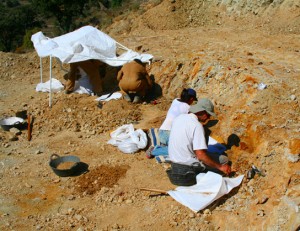
Paleontology, some other branch of biology, uses fossils to study life's history. Zoology and phytology are the study of animals and plants, respectively. Biologists can also specialize every bit biotechnologists, ecologists, or physiologists, to proper noun just a few areas. Biotechnologists use the noesis of biology to create useful products. Ecologists study the interactions of organisms in their environments. Physiologists written report the workings of cells, tissues and organs. This is but a small sample of the many fields that biologists can pursue. From our own bodies to the earth we live in, discoveries in biology can bear on usa in very straight and important means. Nosotros depend on these discoveries for our health, our food sources, and the benefits provided past our ecosystem. Because of this, knowledge of biology can benefit us in making decisions in our twenty-four hours-to-day lives.
The development of technology in the twentieth century that continues today, specially the technology to describe and manipulate the genetic cloth, DNA, has transformed biology. This transformation will allow biologists to continue to understand the history of life in greater detail, how the human body works, our human origins, and how humans can survive as a species on this planet despite the stresses caused by our increasing numbers. Biologists continue to decipher huge mysteries about life suggesting that we have only begun to empathize life on the planet, its history, and our relationship to information technology. For this and other reasons, the knowledge of biology gained through this textbook and other printed and electronic media should be a benefit in whichever field you enter.
Forensic Scientist
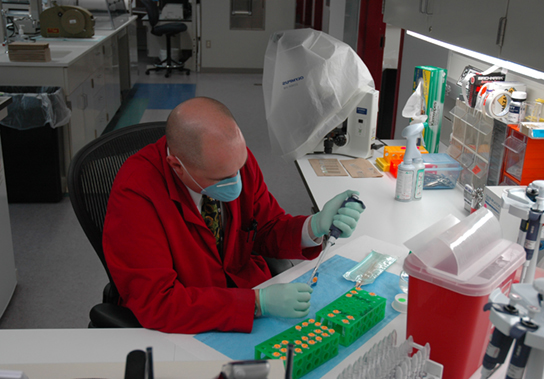
Forensic science is the application of science to reply questions related to the law. Biologists as well as chemists and biochemists can exist forensic scientists. Forensic scientists provide scientific evidence for use in courts, and their chore involves examining trace textile associated with crimes. Interest in forensic scientific discipline has increased in the final few years, possibly because of popular television shows that characteristic forensic scientists on the job. Too, the development of molecular techniques and the establishment of Dna databases have updated the types of work that forensic scientists can practise. Their job activities are primarily related to crimes against people such as murder, rape, and assault. Their work involves analyzing samples such as hair, blood, and other body fluids and also processing Dna found in many dissimilar environments and materials. Forensic scientists as well clarify other biological prove left at crime scenes, such as insect parts or pollen grains. Students who want to pursue careers in forensic science will most likely exist required to take chemical science and biological science courses equally well as some intensive math courses.
Section Summary
Biology is the science of life. All living organisms share several key backdrop such as guild, sensitivity or response to stimuli, reproduction, adaptation, growth and development, regulation, homeostasis, and free energy processing. Living things are highly organized following a hierarchy that includes atoms, molecules, organelles, cells, tissues, organs, and organ systems. Organisms, in turn, are grouped every bit populations, communities, ecosystems, and the biosphere. Development is the source of the tremendous biological variety on Globe today. A diagram called a phylogenetic tree tin be used to show evolutionary relationships among organisms. Biology is very wide and includes many branches and sub disciplines. Examples include molecular biological science, microbiology, neurobiology, zoology, and botany, among others.
atom: a basic unit of matter that cannot be broken downwards by normal chemic reactions
biological science: the study of living organisms and their interactions with one some other and their environments
biosphere: a collection of all ecosystems on Globe
cell: the smallest fundamental unit of construction and part in living things
community: a set of populations inhabiting a particular surface area
ecosystem: all living things in a particular expanse together with the abiotic, nonliving parts of that environment
eukaryote: an organism with cells that have nuclei and membrane-bound organelles
evolution: the process of gradual change in a population that can also lead to new species arising from older species
homeostasis: the ability of an organism to maintain constant internal conditions
macromolecule: a large molecule typically formed by the joining of smaller molecules
molecule: a chemical structure consisting of at least two atoms held together by a chemical bond
organ: a structure formed of tissues operating together to perform a common function
organ organisation: the higher level of system that consists of functionally related organs
organelle: a membrane-bound compartment or sac within a cell
organism: an individual living entity
phylogenetic tree: a diagram showing the evolutionary relationships among biological species based on similarities and differences in genetic or physical traits or both
population: all individuals within a species living within a specific area
prokaryote: a unicellular organism that lacks a nucleus or any other membrane-bound organelle
tissue: a grouping of similar cells carrying out the same role
Media Attribution
- Figure 1.2 past Ivengo(RUS) © Public Domain
- Effigy one.three past Alex Lomas © CC By (Attribution)
- Figure one.iv past Pieter & Renée Lanser © CC BY (Attribution)
- Effigy 1.5 by David © CC Past (Attribution)
- Figure ane.half dozen by Pacific Southwest Region USFWS © CC BY (Attribution)
- Effigy one.7 by Brian0918 © Public Domain
- Figure 1.8
- "molecule": modification of piece of work past Jane Whitney;
- "organelles": modification of work by Louisa Howard;
- "cells": modification of work by Bruce Wetzel, Harry Schaefer, National Cancer Constitute;
- "tissue": modification of piece of work by "Kilbad" © Public Domain
- "organs": modification of work by Mariana Ruiz Villareal, Joaquim Alves Gaspar;
- "organisms": modification of work past Peter Dutton;
- "ecosystem": modification of work by "gigi4791″ © CC By (Attribution)
- "biosphere": modification of piece of work by NASA © Public Domain
- Figure ane.ten
- EscherichiaColi NIAID: modification of work past Rocky Mount Laboratories, NIAID, NIH © Public Domain
- Extremophiles modification of work by Steve Jurvetson © CC Past (Attribution)
- Sunflower modification of work by Michael Arrighi
- Lion modification of piece of work by Frank Vassen © CC BY (Attribution)
- Figure i.12 by Mario Modesto © Public Domain
- Figure 1.thirteen by U.S. Army CID Control Public Diplomacy
Source: https://opentextbc.ca/biology/chapter/1-1-themes-and-concepts-of-biology/

Postar um comentário for "Reviewing Key Concepts Major Animal Phyla Mastering Biology Answers"