Whos the Greek That Had to Keep Rolling a Bottle of Pills Only to Have It Roll Down Again
Sisyphus (or Sisyphos) is a effigy from Greek mythology who, as king of Corinth, became infamous for his general trickery and twice adulterous death. He ultimately got his comeuppance when Zeus dealt him the eternal punishment of forever rolling a boulder upwardly a hill in the depths of Hades. Founder of the Isthmian Games and grandad of Bellerophon, he is nowadays all-time remembered equally a poignant symbol of the folly of those who seek to trifle with the natural gild of things and avoid humanity'south lamentable simply inescapable lot of mortality. The adjective Sisyphean denotes a task which tin can never be completed.
Cheating Expiry
In Greek mythology, the story of Sisyphus has multiple and often contradictory versions with embellishments added over time so that the only signal of certainty is his terrible punishment. He was the son of Aeolus, described by Homer as a human who rules the winds. Sisyphus is credited with being the founder and kickoff king of Corinth. He gained infamy for his trickery and wicked intelligence, but his greatest feat was to cheat death and Hades himself, non once but twice, thus living up to Homer'southward description of him as "the most cunning of men" (Iliad, 6:153). In the first episode the male monarch, after dying and descending into Hades, audaciously managed to capture Thanatos, the personification of Decease, and concatenation him up so that no humans died thereafter. Only the intervention of Ares resolved the crisis, and Death was freed to pursue his natural work.
The king of the gods made sure that humans would not be encouraged past the feats of the trickster Sisyphus.
The second episode proved more successful. After dying for the second fourth dimension and once more finding himself in the shady underworld, Sisyphus persuaded Hades to permit him out back into the bright realm of the living. For the rex had cleverly arranged for his wife not to provide the usual offerings and sacrifices that were due on her husband'southward death. Working on the kind-hearted wife of Hades, Persephone, the king pleaded that if he were released he would be able to instruct his married woman to deport out the proper rituals and all would be well. On his release, Sisyphus, naturally, made no effort to return to Hades but lived to a ripe one-time age, largely thanks to Death now not wanting to go anywhere nigh him following his previous experience of being put in chains.
Zeus' Penalization
When the king died all the same again, there was to be no escape for him this time equally Zeus himself now intervened. The king of the gods fabricated certain that humans would not be encouraged by the feats of the trickster Sisyphus. His fate would have to be long and slow. In Homer's Odyssey the hero Odysseus descends into Hades and, coming across many a fallen hero, he sees Sisyphus and his eternal punishment:
Then I witnessed the torture of Sisyphus, as he wrestled with a huge stone with both hands. Bracing himself and thrusting with hands and feet he pushed the boulder uphill to the top. But every time, every bit he was about to send it toppling over the crest, its sheer weight turned information technology back, and one time again towards the apparently the pitiless stone rolled down. And so once again he had to wrestle with the thing and push it up, while the sweat poured from his limbs and the dust rose high above his head. (Odyssey, Book 11:593)
Autolycus & Other Associations
In another tale, Sisyphus used his cunning to finally take hold of Autolycus, the grandpa of Odysseus and infamous thief. Sisyphus cleverly fastened lead tablets to the feet of his own cattle herd, and then when Autolycus stole them, Sisyphus was able to follow the tracks and catch the thief red-handed. The tablets had all been inscribed with the words 'Autolycus stole them.'
The Punishment of Sisyphus
Sisyphus was also the founder of the famous Isthmian games of Corinth, held every two years in honour of Poseidon, and 1 of the four major Panhellenic games which included the Olympic games. Sisyphus was succeeded every bit male monarch of Corinth by his son Glaucus – he who was ripped to pieces by his ain flesh-eating horses – and so his grandson Bellerophon, whose winged horse Pegasus became a symbol of the city and a characteristic of Corinthian coins.
Sisyphus in Art
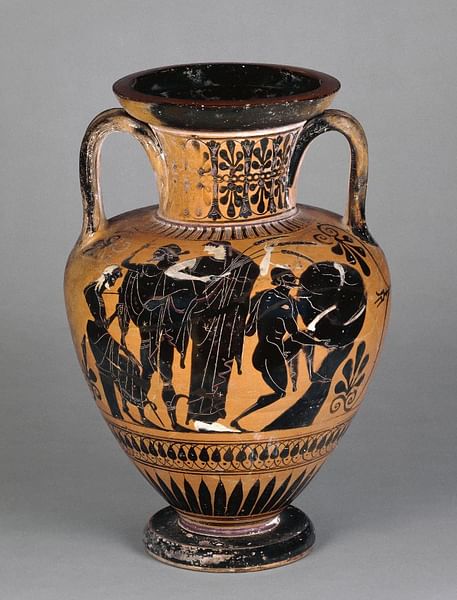
The Underworld was a relatively rare field of study for Greek vase painters, just there are a dozen or so vases from the 6th century BCE showing Sisyphus. On one Athenian black-figure amphora, dating to c. 510 BCE and now in the British Museum, a scene of Sisyphus' penalization is captured. The trickster pushes a huge boulder up a slope using his arms and a knee while Hades, Persephone, and Hermes look on. Another example is a black-figure amphora in the Staatliche Antikensammlungen of Munich which dates to 530 BCE and again shows Persephone looking on as Sisyphus carries his boulder, this fourth dimension, unusually painted in white. The boulder pusher myth returns in popularity during the quaternary century BCE when it is shown on the interior of several ruby-figure cups and appears on a number of similar-dated red-figure vases which prove multiple figures from the Underworld. In one of the latter examples, Sisyphus has the boosted punishment of being whipped by ane of the Furies who wears a panther pare.
In sculpture, Sisyphus appears on a c. 540 BCE sandstone metope from the Heraion of Foce del Sele near Paestum. Here the hapless trickster not merely has to roll his stone upwardly a very steep-looking hill but is at the same time attacked from backside past a winged demon.
This article has been reviewed for accuracy, reliability and adherence to academic standards prior to publication.
Source: https://www.worldhistory.org/sisyphus/

Postar um comentário for "Whos the Greek That Had to Keep Rolling a Bottle of Pills Only to Have It Roll Down Again"